
Rungu: The History, Symbolism, and Legacy of the African Club
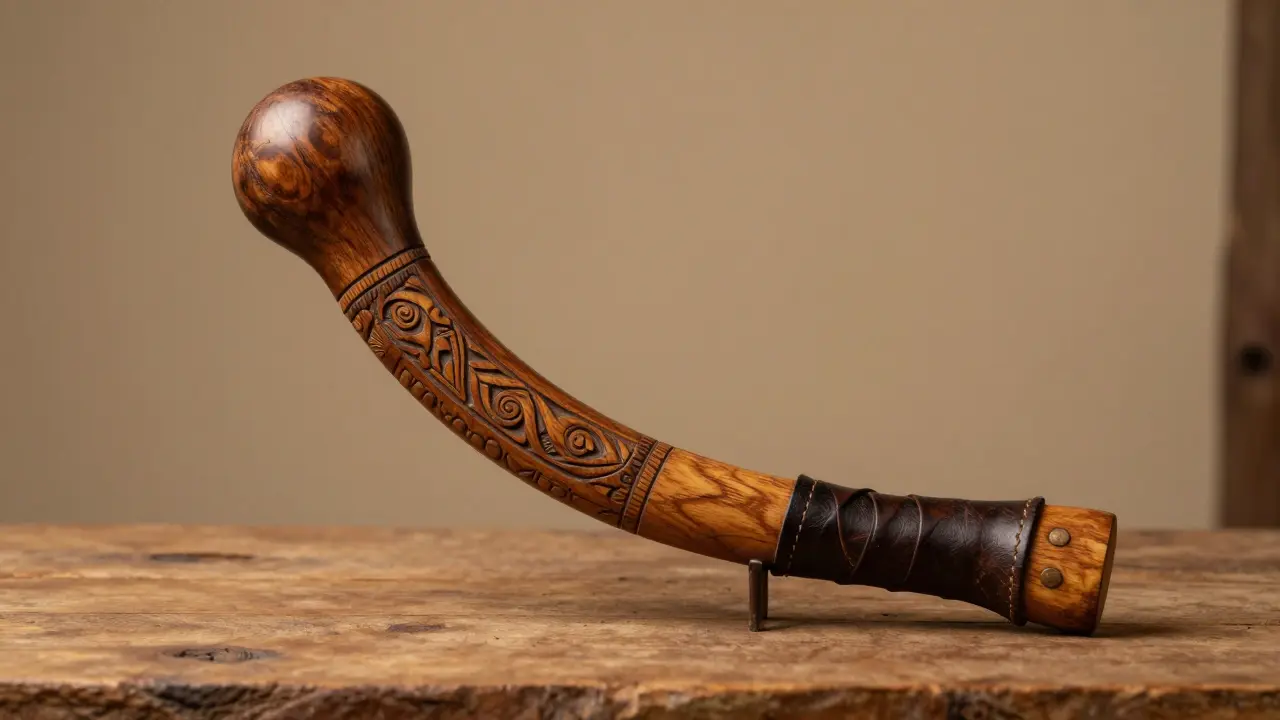
You’ve likely seen it in movies or historical illustrations-a heavy, curved wooden club held by a warrior. But to reduce the rungu is a traditional wooden club used across East Africa, particularly among the Kikuyu and other Bantu-speaking peoples, serving as both a weapon of war and a symbol of authority. Also known as African club, it was first documented extensively during colonial encounters but has roots stretching back centuries before European contact. It’s not just a blunt instrument; it’s a piece of living history that tells us how communities organized, defended themselves, and expressed power long before modern borders existed.
When we talk about the rungu, we aren’t just talking about wood and knots. We’re talking about social structure, craftsmanship, and the complex reality of pre-colonial African societies. Many people assume these tools were crude, but they were highly specialized. A rungu wasn’t something you picked up off the ground. It was carved, balanced, and often personalized for its owner. Understanding this object helps us dismantle stereotypes about African history being static or primitive. Instead, we see a dynamic culture with sophisticated martial traditions and deep symbolic meanings attached to everyday objects.
The Anatomy of a Rungu
To understand why the rungu was effective, you have to look at its design. It’s not a simple stick. The shape is deliberate. Most rungus feature a distinct curve or a bulbous head, which serves a specific mechanical purpose. When swung, the weight distribution allows for greater momentum and impact force than a straight staff of equal length. This makes it devastatingly effective in close-quarters combat, where speed and precision matter more than reach.
| Feature | Function | Material Source |
|---|---|---|
| Curved Head | Increases leverage and striking surface area | Dense hardwoods like Mukau (Baobab) |
| Ergonomic Grip | Prevents slipping during intense use | Carved grooves or wrapped leather |
| Weight Balance | Allows for rapid swings and quick recovery | Natural wood density variations |
| Decorative Carvings | Identifies clan affiliation or status | Burned or incised patterns |
The materials used were just as important as the shape. Craftsmen didn’t just pick any tree. They sought out dense, resilient hardwoods. In Kenya, for example, the Baobab tree (Mukau) was prized for its strength and durability. Other regions might use ironwood or similar species. The process of carving a rungu took time. A skilled artisan would select a branch with the right natural curve, then refine it over weeks. This isn’t mass production; it’s bespoke craftsmanship. Each rungu was unique, much like a signature today.
But here’s the thing most guides miss: the rungu wasn’t always carried into battle. For many men, it was part of daily life. Farmers carried them while working in fields to deter wild animals like lions or hyenas. Herders used them to protect livestock from predators. So, the line between a tool for survival and a weapon of war was blurry. This dual purpose meant that almost every adult male in certain communities was trained in its use from a young age.
Cultural Symbolism and Social Status
If you think the rungu was just about hitting things, you’re missing half the story. In many East African cultures, particularly among the Kikuyu, the rungu was a powerful symbol of masculinity and authority. A man without a rungu was often seen as incomplete or lacking in protective capability. It represented his ability to defend his family, his community, and his honor.
Think of it like a badge of office, but one you had to earn through skill and respect. Elders who served as judges or leaders often carried ornate rungus. These weren’t necessarily for fighting-they were visual cues that said, "This person has authority." When an elder spoke while holding his rungu, the community listened. The object commanded attention. It was a non-verbal way of establishing hierarchy in societies that relied heavily on oral tradition and consensus.
This symbolism extended to rites of passage. Young men undergoing initiation ceremonies might receive their first rungu as a sign of their transition into adulthood. It marked the moment they became responsible for their own safety and the safety of others. The ceremony wasn’t just about receiving a tool; it was about accepting a role within the social fabric. The rungu connected the individual to the collective identity of the tribe.
Interestingly, the rungu also played a role in spiritual practices. Some communities believed that the spirit of the ancestor resided in the wood, especially if the tree had been chosen through ritual. Carvers would perform blessings before beginning work. This added a layer of sacredness to the object. It wasn’t just wood; it was a vessel for protection and ancestral guidance. This belief reinforced the idea that the rungu was a partner in life, not just a tool for violence.
Rungu vs. Other Traditional Weapons
It’s easy to lump all traditional African weapons together, but that’s a mistake. The rungu had distinct advantages and disadvantages compared to other tools like spears, shields, or bows. Understanding these differences helps explain why it remained popular even as other technologies evolved.
| Weapon | Primary Use | Range | Training Required |
|---|---|---|---|
| Rungu | Close combat, defense, authority | Short (1-3 feet) | Moderate (balance and timing) |
| Spear | Thrusting, throwing, hunting | Medium to Long | High (precision and strength) |
| Shield | Defense only | None | Low (positioning) |
| Bow and Arrow | Hunting, ranged attack | Long | Very High (aim and draw strength) |
The spear, for instance, required significant training to master effectively. You needed to know how to throw accurately or thrust with lethal precision. The bow and arrow demanded even more skill and physical strength. The rungu, however, was intuitive. If you could swing your arm, you could cause damage. This made it accessible to a wider range of people, including older warriors who might lose the agility needed for spear fighting.
However, the rungu had limitations. It was useless against an enemy at a distance. If you faced someone with a bow, you were in trouble unless you could close the gap quickly. This is why warriors often carried multiple weapons. A typical fighter might have a shield for defense, a spear for mid-range, and a rungu for when things got too close. This combination created a versatile toolkit that adapted to different battlefield scenarios.
Another key difference is portability. A long spear is cumbersome to carry while farming or herding. A rungu fits easily in a handbag or can be tucked under an arm. This convenience contributed to its widespread adoption. It was the perfect "everyday carry" weapon for a society where conflict could erupt suddenly and anywhere.
The Colonial Era and Misinterpretation
When European colonizers arrived in East Africa in the late 19th century, they encountered the rungu with a mix of fear and misunderstanding. To them, it looked like a primitive club, reinforcing their narrative of African savagery. They failed to see the sophistication behind its design or the cultural weight it carried. This misinterpretation had real consequences.
Colonial authorities often banned the carrying of rungus, labeling them as illegal weapons. This wasn’t just about disarming populations; it was about stripping away symbols of indigenous authority. By banning the rungu, colonizers attacked the social structures that gave local leaders power. It was a psychological blow as much as a military one. Communities resisted, sometimes secretly crafting rungus or using them in rebellions.
One notable example is the Mau Mau uprising in Kenya. While firearms played a role, traditional weapons like the rungu were still used by fighters who lacked access to guns. These rebels saw the rungu as a connection to their ancestors and a rejection of colonial rule. It became a symbol of resistance, not just a tool of war. This shift in meaning shows how objects can adapt to new political contexts.
Yet, despite these efforts to suppress it, the rungu survived. It persisted in rural areas where colonial control was weaker. And even after independence, it remained a potent symbol. Today, you’ll still see rungus displayed in museums, worn as ceremonial items, or used in traditional dances. Its endurance is a testament to the resilience of African culture in the face of external pressure.
Modern Relevance and Preservation
So, what happens to a traditional weapon in the 21st century? Does it become obsolete? Not entirely. The rungu has found new roles in modern East Africa. It’s no longer a primary tool for defense, thanks to modern policing and firearms laws. But it lives on in other ways.
First, there’s tourism and cultural heritage. Many communities now produce rungus as souvenirs or art pieces. These aren’t just cheap knockoffs; some are crafted by master artisans who preserve traditional techniques. Buying a rungu directly supports these craftspeople and keeps the knowledge alive. It’s a way for younger generations to connect with their history without engaging in violence.
Second, the rungu appears in contemporary art and fashion. Designers incorporate its shapes into jewelry, sculptures, and clothing. This recontextualization challenges old stereotypes and presents the rungu as a symbol of beauty and strength rather than brutality. It’s a subtle but powerful act of reclaiming narrative.
Finally, there’s education. Schools and cultural centers teach children about the history of the rungu. They learn how it was made, who used it, and why it mattered. This ensures that the next generation understands its significance beyond its physical form. It’s not just a relic; it’s a lesson in identity and pride.
Of course, there are challenges. Globalization threatens traditional crafts. Younger people may prefer modern jobs over learning woodworking. But initiatives led by local NGOs and government bodies are helping to preserve these skills. Workshops and festivals celebrate the rungu as part of intangible cultural heritage. These efforts are crucial for maintaining diversity in a homogenizing world.
How to Identify an Authentic Rungu
If you’re interested in acquiring a rungu-whether for study, decoration, or support of artisans-it’s important to know what you’re looking for. Mass-produced imitations flood the market, often made from soft woods or plastic. Here’s how to spot the real deal.
- Wood Density: An authentic rungu feels heavy for its size. Tap it lightly; it should sound solid, not hollow. Soft woods like pine will dent easily.
- Grain Pattern: Look for natural grain lines. Machine-made copies often have uniform, artificial patterns. Real wood has irregularities and character marks.
- Finish: Traditional rungus are usually oiled or polished by hand, not painted. Paint can chip and looks unnatural. Oil enhances the wood’s natural color and protects it.
- Carving Details: Check the grip and head. Hand-carved details show slight asymmetries and tool marks. Factory molds create perfect, sterile surfaces.
- Provenance: Buy from reputable sources that can tell you where the wood came from and who made it. Supporting ethical trade ensures fair compensation for artisans.
Avoid items labeled as "decorative only" if they claim to be traditional. Often, this is a legal loophole to sell poorly made goods. Instead, seek out vendors specializing in African art or direct partnerships with cooperatives. Your purchase can make a difference in preserving this craft.
Is it legal to own a rungu in the United States?
Yes, owning a rungu is generally legal in the U.S., provided it is not classified as a concealed weapon or made from restricted materials. However, laws vary by state and city. Some jurisdictions may require permits for carrying bludgeoning weapons in public. Always check local regulations before purchasing or transporting one. If kept as home decor or a collector’s item, issues are rare.
What is the difference between a rungu and a macuahuitl?
While both are traditional clubs, they come from completely different cultures. The rungu is East African, typically made of solid wood with a curved head. The macuahuitl is Aztec, originating in Mesoamerica. It was a wooden sword embedded with obsidian blades, designed for cutting rather than blunt force. Confusing the two ignores their distinct historical and technological contexts.
Can a rungu be used for self-defense today?
Technically, yes, but it is impractical and potentially illegal depending on your location. Modern self-defense relies on de-escalation and legal tools like pepper spray. Using a blunt weapon can escalate situations dangerously and lead to severe legal consequences. The rungu is best appreciated as a cultural artifact rather than a functional defense tool in contemporary settings.
Which African tribes primarily used the rungu?
The rungu is most strongly associated with the Kikuyu people of Kenya. However, similar clubs were used by other Bantu-speaking groups across East and Central Africa, including the Luhya, Kamba, and Maasai (though the Maasai preferred spears). Each group had slight variations in design based on local resources and preferences.
How do I care for a wooden rungu to prevent cracking?
Store your rungu in a stable environment with consistent humidity. Avoid direct sunlight, which can dry out the wood and cause cracks. Apply a light coat of mineral oil or beeswax every few months to maintain moisture. Never use harsh chemicals or water to clean it. Handle it gently to avoid chips or dents that compromise its structural integrity.