How to Incorporate Reflexology into Your Self-Care Routine
Most people think self-care means bubble baths and face masks, but what if your feet hold the key to real relaxation? Reflexology isn’t just a foot rub-it’s a simple, science-backed way to calm your nervous system, ease tension, and reset your whole body. You don’t need a spa appointment or expensive tools. Just your hands, 10 minutes a day, and a willingness to listen to your body.
What Reflexology Actually Does
Reflexology is based on the idea that specific areas on your feet, hands, and ears connect to organs and systems in your body. Pressing these spots sends signals to your nervous system, helping reduce stress, improve circulation, and ease pain. It’s not magic-it’s neurology. Studies from the Journal of Evidence-Based Complementary & Alternative Medicine show that regular foot reflexology lowers cortisol levels and improves sleep quality in people with chronic stress.
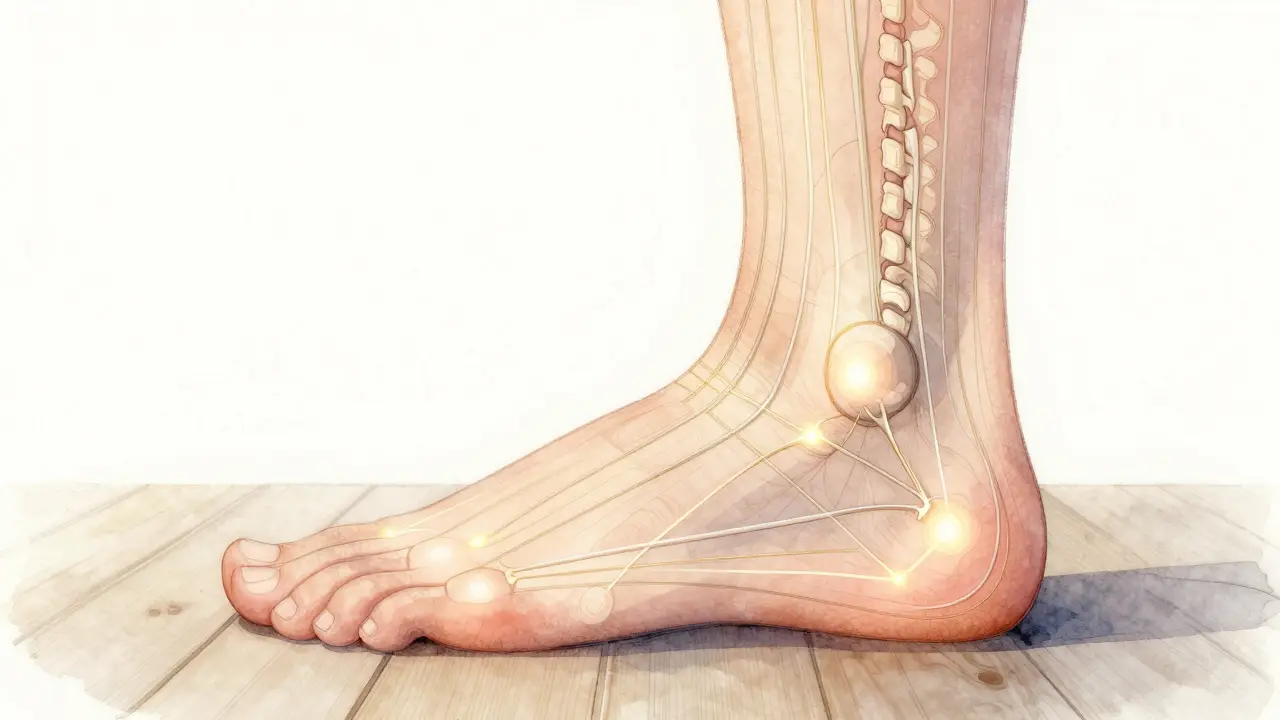
Think of your feet like a map. The ball of your foot links to your chest and lungs. Your heel connects to your lower back and pelvis. The arch runs along your spine. When you press these areas, you’re not just touching skin-you’re talking to your body.
Why It Works Better Than You Think
Most self-care routines are passive: you scroll, you sip tea, you lie down. Reflexology is active healing. It forces you to slow down, focus, and engage. That’s why it’s more effective than passive relaxation. A 2023 study in Australia found that participants who did 10 minutes of daily foot reflexology reported a 40% drop in perceived stress within two weeks-better than those who only meditated or took walks.
It also doesn’t require you to change your schedule. You can do it while watching TV, waiting for your coffee to brew, or before bed. No special equipment. No training. Just pressure.
How to Start: A Simple 10-Minute Routine
Here’s how to begin-no experience needed.
- Find a quiet spot. Sit in a chair with your feet flat on the floor. Remove socks and shoes.
- Use your thumbs. They’re your best tool. Keep your fingers relaxed. Don’t use your fingernails.
- Start with the ball of your right foot. Press gently but firmly in a circular motion for 30 seconds. This area relates to your heart and lungs.
- Move to the arch. Use your thumb to trace a line from the heel to the ball. Apply steady pressure. Do this for 45 seconds. This connects to your spine and digestion.
- Press the inner edge of your foot, just below the ankle. This is your kidney and bladder zone. Hold for 30 seconds.
- Work your way to the heel. Squeeze gently. This helps with lower back tension.
- Repeat on the left foot.
Don’t worry about getting every spot perfect. Your body will tell you where it needs attention. If a spot feels tender, hold it a little longer. That’s your body saying, “Hey, I need this.”
When to Do It (And When Not To)
The best times are morning (to wake up your system) or before bed (to wind down). Many people find it helps with insomnia. One woman in Sydney told me she started doing this after her night shifts, and within a week, she stopped waking up at 3 a.m. with anxiety.
Avoid reflexology if you have:
- An open wound or infection on your foot
- Recent foot surgery (wait at least six weeks)
- Deep vein thrombosis (DVT)
- Severe diabetes with neuropathy (talk to your doctor first)
If you’re pregnant, it’s generally safe-but avoid the inner ankle area, which can stimulate contractions. Always listen to your body. If it hurts too much, ease up.
What You’ll Feel (And What You Won’t)
You won’t suddenly feel healed. Reflexology isn’t a cure-all. But you will notice small shifts: your shoulders drop lower when you sit. Your breathing gets deeper. You stop clenching your jaw. These are real changes.
Some people feel a tingling in their hands or face after pressing their feet. That’s your nervous system waking up. Others feel sleepy. That’s normal. Your body is shifting from fight-or-flight to rest-and-digest mode.
Don’t expect miracles. But if you do this for 10 minutes a day for two weeks, you’ll likely notice you’re less reactive to stress. You’ll sleep better. You’ll feel more grounded.
Pair It With Other Habits
Reflexology works best as part of a routine. Try this:
- Do it after a warm foot soak. Add Epsom salts or a few drops of lavender oil.
- Use a small massage ball under your foot while sitting at your desk. Roll it slowly for 2 minutes every hour.
- Combine it with deep breathing. Inhale for four counts, hold for four, exhale for six. Match your breath to your thumb pressure.
- Keep a journal. Note how you feel before and after. You’ll start seeing patterns.
One man I spoke to in Melbourne started doing reflexology after his back pain returned. He added a 5-minute foot rub before his morning stretch. Within three weeks, he cut his painkiller use in half.
Common Mistakes to Avoid
People often think reflexology means pressing hard. It doesn’t. Too much pressure causes bruising and tension, not relief. Use firm, steady pressure-not a massage gun.
Another mistake: doing it once and giving up. Like yoga or journaling, it builds over time. One session won’t change your life. Ten minutes a day for 30 days might.
And don’t expect your therapist to do it for you every time. The power of reflexology is in doing it yourself. It’s not a service-it’s a skill you build.
Real Results, Not Hype
Reflexology isn’t a replacement for medical care. But for people dealing with stress, poor sleep, or mild chronic pain, it’s one of the most underused tools available. It’s free. It’s safe. And it takes less time than scrolling through your phone.
Thousands of people in Australia, the U.S., and the U.K. are already using it. You don’t need a certification. You don’t need a clinic. You just need your feet and five minutes to start.
Try it tonight. Sit down. Take off your socks. Press your thumb into the ball of your foot. Breathe. See what happens.
Can reflexology help with anxiety?
Yes. Studies show reflexology reduces cortisol, the main stress hormone. Many people report feeling calmer, sleeping better, and reacting less sharply to stress after consistent practice. It doesn’t replace therapy, but it’s a powerful daily tool to calm the nervous system.
Do I need special tools or oils?
No. Your thumbs are enough. You can use a little lotion or coconut oil if you like-it helps your fingers glide-but it’s not required. Avoid expensive reflexology maps or gadgets. They don’t make it more effective. Simplicity works best.
How long until I see results?
Some feel calmer after one session. For lasting changes-better sleep, less tension, reduced anxiety-most people notice a difference after 7 to 14 days of daily practice. Consistency matters more than duration.
Can I do reflexology on my hands instead of my feet?
Yes. Hand reflexology works the same way. The points on your hands mirror those on your feet. It’s a good alternative if your feet are sore, swollen, or hard to reach. Many people use it at their desk during breaks.
Is reflexology scientific?
It’s not fully understood, but research supports its effects. Multiple studies show measurable drops in stress hormones, improved circulation, and better sleep. The mechanism is likely neurological-pressure on the feet sends signals to the brain that trigger relaxation responses. It’s not pseudoscience; it’s under-researched physiology.